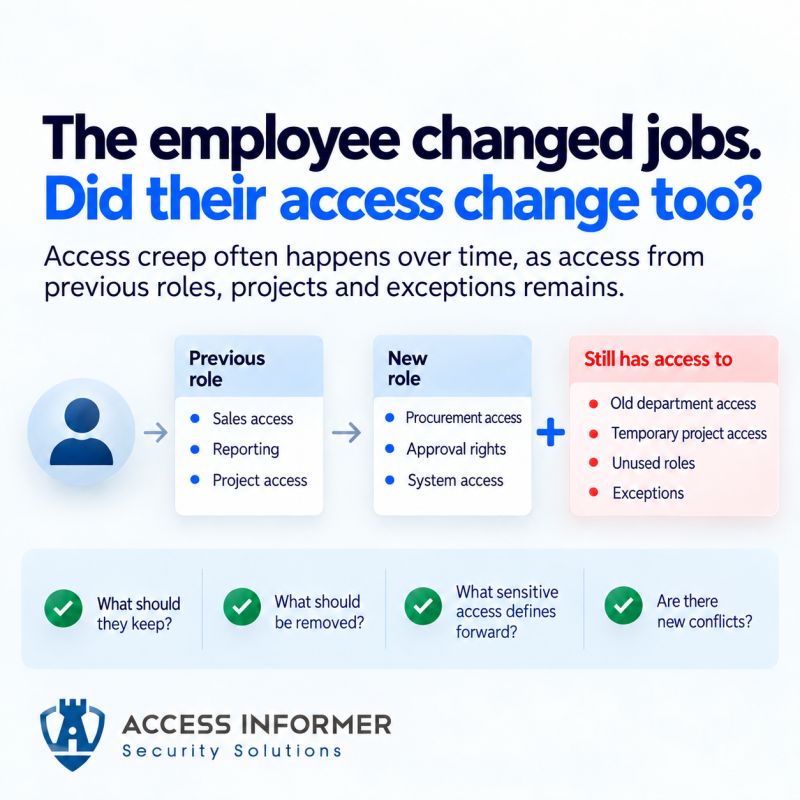
This is one of the simplest ways access creep happens.
Someone moves from one department to another.
They receive the access required for the new job.
But some of the old access stays.
Nothing immediately breaks.
The user continues working.
And over time, their access becomes a combination of:
• What they need now
• What they needed before
• Temporary access from a past project
• Exceptions that were never removed
After several years, that can become difficult to untangle.
The interesting part is that each individual access decision may have been completely
reasonable at the time.
The problem appears through accumulation.
That’s why employee transfers deserve just as much attention as new joiners and leavers.
When someone changes roles, you should be able to ask:
✅ What access should they keep?
✅ What should be removed?
✅ What new conflicts are being created?
✅ What sensitive access are they carrying forward?
✅ Are old role assignments still necessary?
Access creep usually doesn’t happen because someone made one terrible decision.
It happens because nobody revisits hundreds of small decisions.
And eventually, those small decisions add up.